
I watched my first real user for two weeks. My favorite feature died.
Quick orientation if this is your first time here: I build Hotari, an app that turns your daily life into an RPG. You log what you did, and an AI Scribe writes a short story about your growth while five life stats rise on a radar. The launch post has the full origin story.
This post is about the two weeks that rearranged my roadmap.
Before launch, I handed the app to my wife. She was user number one in every sense: not a beta tester with a checklist, just a person living her life with my app on her phone. I set one rule for myself: no coaching. Don’t explain features. Don’t point at buttons. Just watch what she does when I’m not performing founder enthusiasm at her.
Day one went exactly like the demo in my head
She settled her first day, the Scribe wrote its take, and she laughed out loud. She read parts of it to me from the couch. She picked the roaster voice, the one that makes fun of you, and let it dunk on her afternoon.
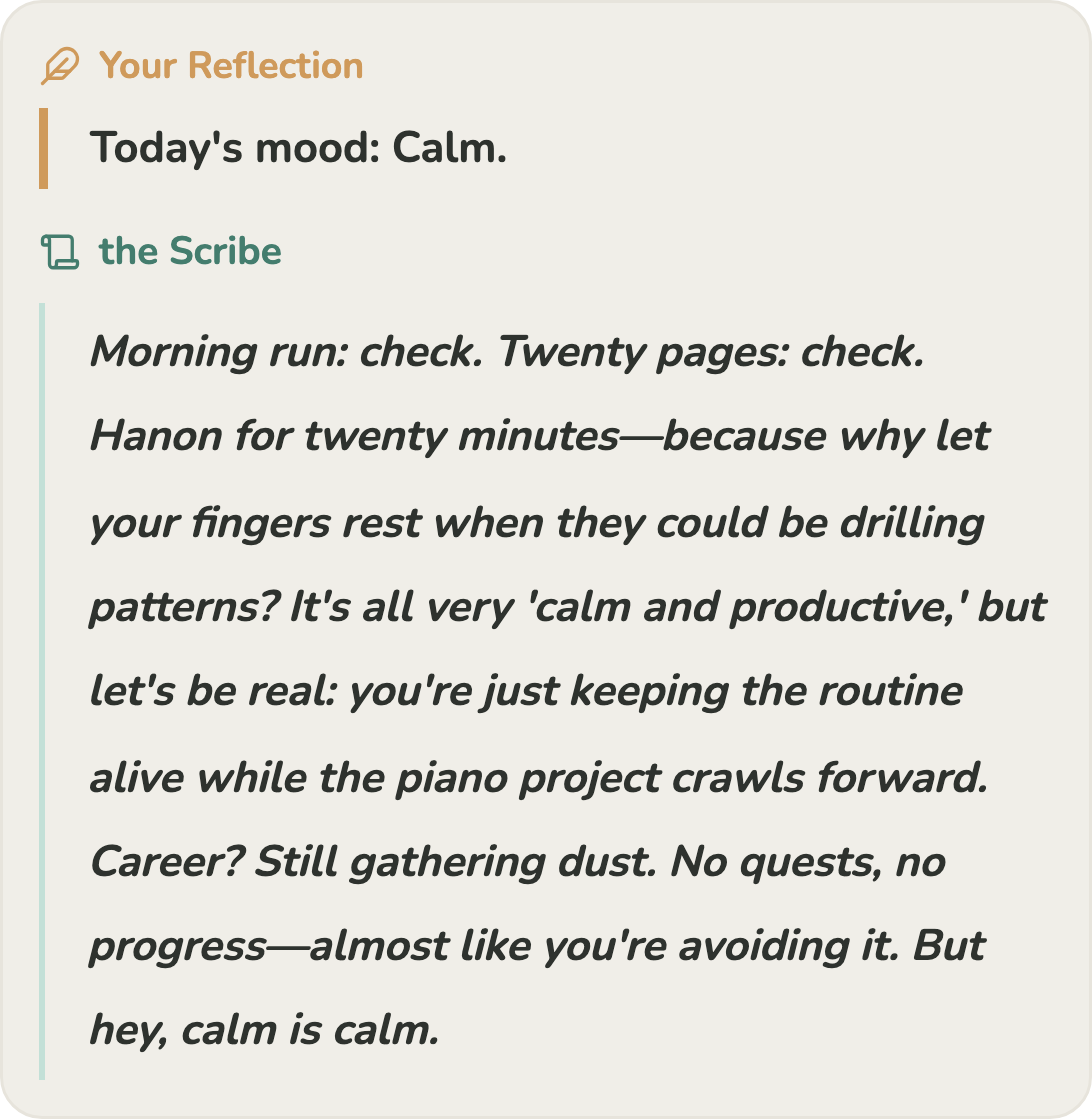
I remember thinking: this is the ad. This is the screenshot that sells the app. Every pitch I’d written led with the Scribe, and day one confirmed all of it.
Day twelve did not
She was still using the app. Logging her day, settling in the evening, no prompting from me. But I watched her settle one night and saw it: the narrative she used to read aloud got a two-second skim. Scroll, glance, close.
Anyone who uses AI products knows this feeling from the inside. The twentieth AI-written anything is furniture. It’s not that the writing got worse; novelty is just a currency that only spends once. I’d built my entire pitch on a feature with a two-week half-life.
The part that stung: I’d have never seen this in a dashboard. Her usage looked identical, opens, settles, retention all fine. The decay was in her eyes, not in the events table.
So why was she still opening it?
Here’s where it gets interesting, and where I have to include myself as the second data point. Because I’d felt the same decay with my own product, months earlier. The narrative had become a pleasant glance for me too. What kept pulling me back was something I’d built almost as an afterthought: the radar chart’s overlay of recent investment versus all-time, which quietly shows which part of your life has gone dark lately.
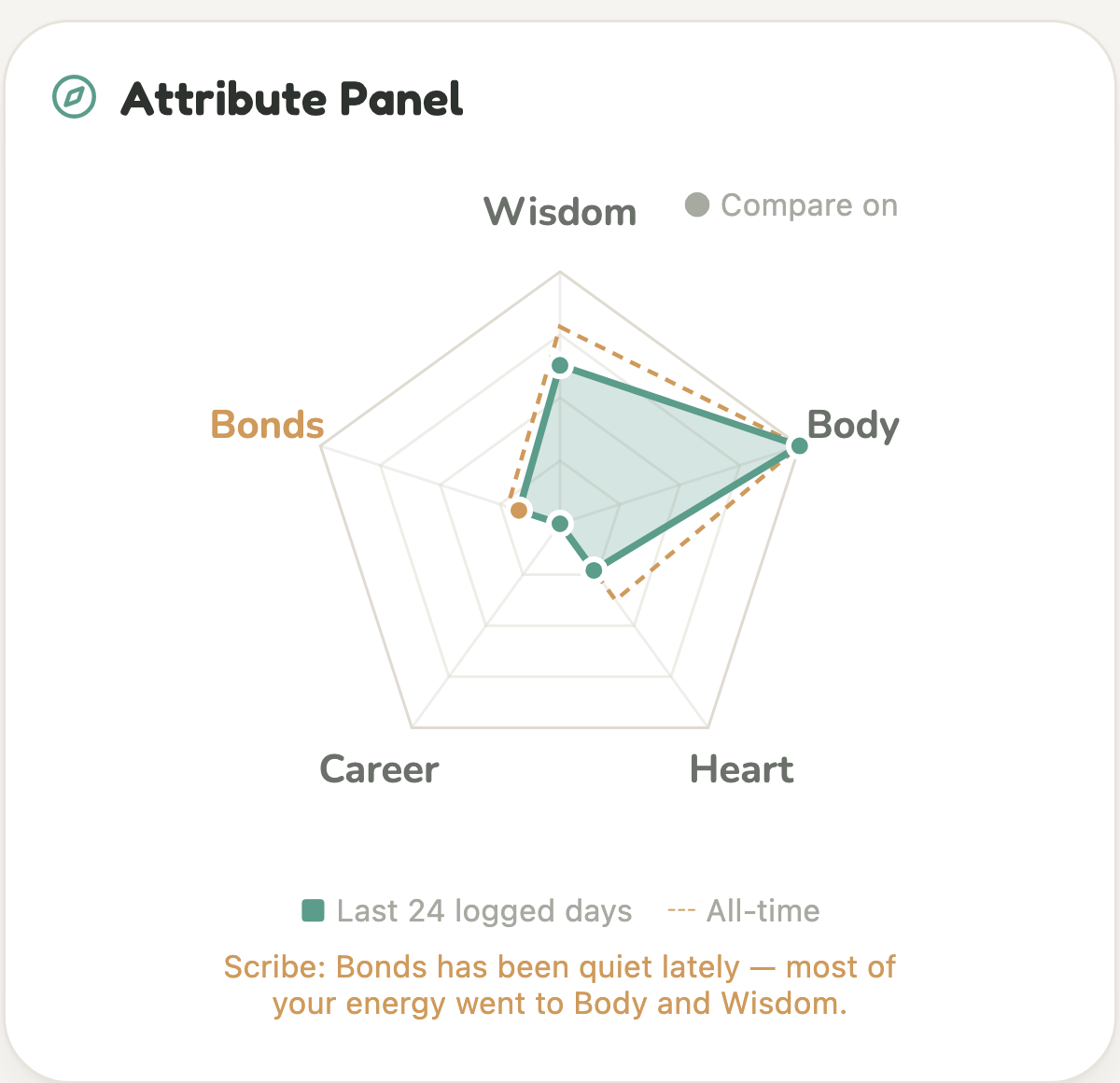
Checking it feels less like entertainment and more like glancing in a mirror before leaving the house. Oh. Bonds has been flat for two weeks. I should call my mom. No badge, no nag, no guilt mechanic. Just a fact about my own recent life that nothing else in the world would have told me.
That’s the difference. The Scribe entertains, and entertainment wears out. The balance mirror answers a question, “what am I neglecting lately?”, and the answer changes every week, so it never wears out. One feature is a story. The other is an instrument.
What I changed
Two things, concretely. First, the balance mirror used to be locked behind weeks of data, on the theory that it needed history to be meaningful. That gate put the durable feature past the point where most people would churn. It now gives its first reading around day three. Second, I stopped positioning the Scribe as the product. It’s the hook, the thing that makes day one magical, and that’s an honorable job. But the retention story belongs to the mirror.
The lesson I’d offer other builders: the feature that demos best and the feature that retains are not necessarily the same feature, and at small scale, two weeks of watching one real human beats any analytics setup you can afford. Dashboards told me she was retained. Only her face told me why.
Hotari is at hotari.app, seven days free, no card. Day one, the Scribe will make you laugh. I’m more curious whether the mirror catches you on day twelve.